The REPL Is Dead. Long Live the Factory.
The chat loop is not enough for reliable AI delivery. The next abstraction is an orchestrated factory with state and gates.
This is a companion piece to my vibe coding devlog series. I made this call in January 2026. Five months in, it's holding. This is the architecture, and the scorecard that backs it.
A 2025 randomized controlled trial by METR found that AI coding tools made experienced developers 19% slower, not faster. Developers predicted a 24% speedup. ML experts predicted 38%. The actual result? A slowdown. On real tasks. With frontier models.
The problem isn't the models. It's the execution pattern.
My prediction for 2026: the year of the orchestrator. The REPL pattern that powers every AI coding tool will evolve, or be replaced by tools that have.
The REPL isn't dead. It's incomplete. Add orchestration, the same discipline that made servers and containers reliable, and you get something that scales to AI agents.
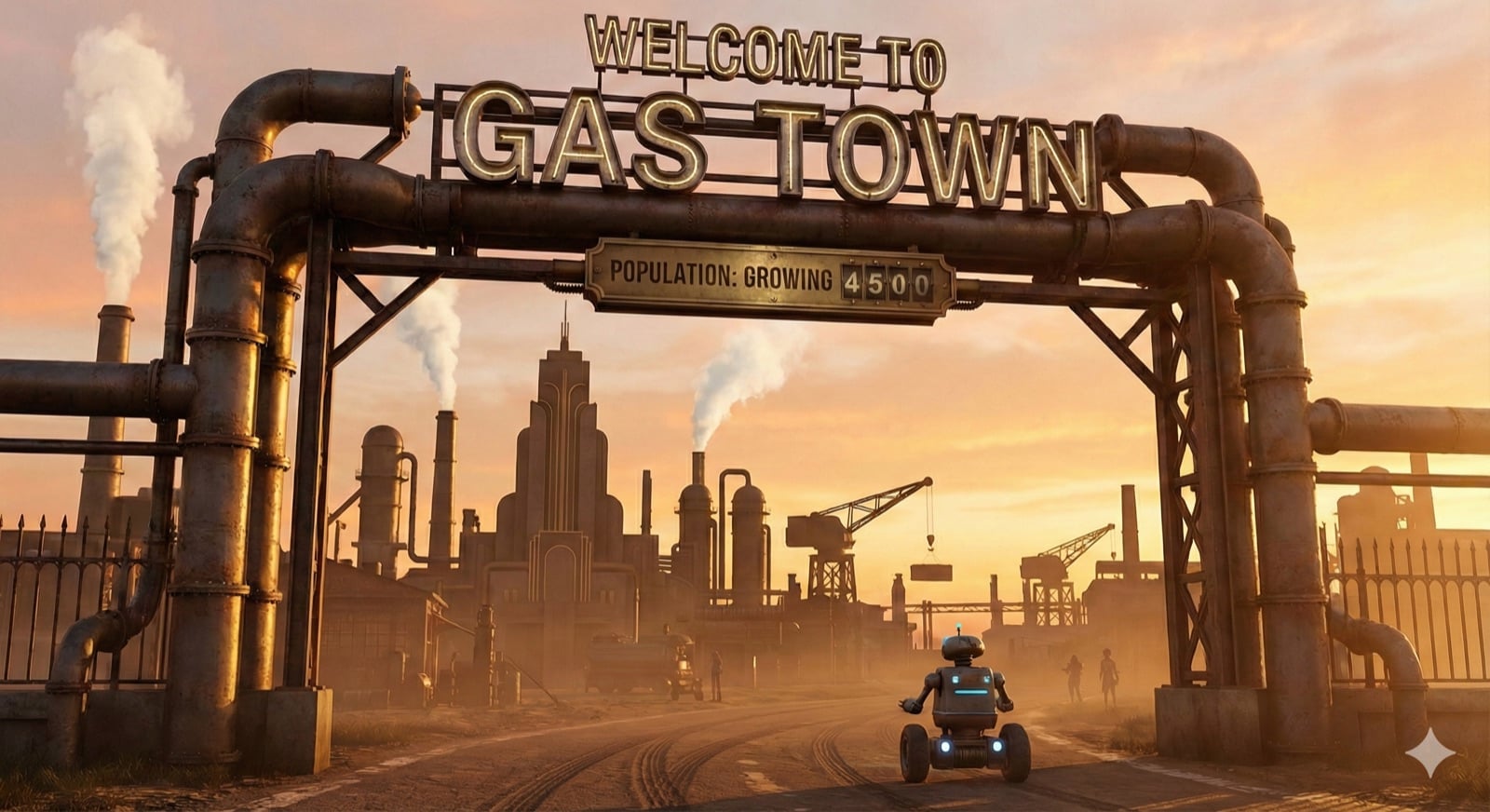
Steve Yegge's Gas Town confirmed what the METR data suggests: the REPL is an incomplete abstraction. The right one looks like Kubernetes: a control plane orchestrating ephemeral workers against a declarative state store. 12-Factor AgentOps applies the same infrastructure patterns to AI workflows.
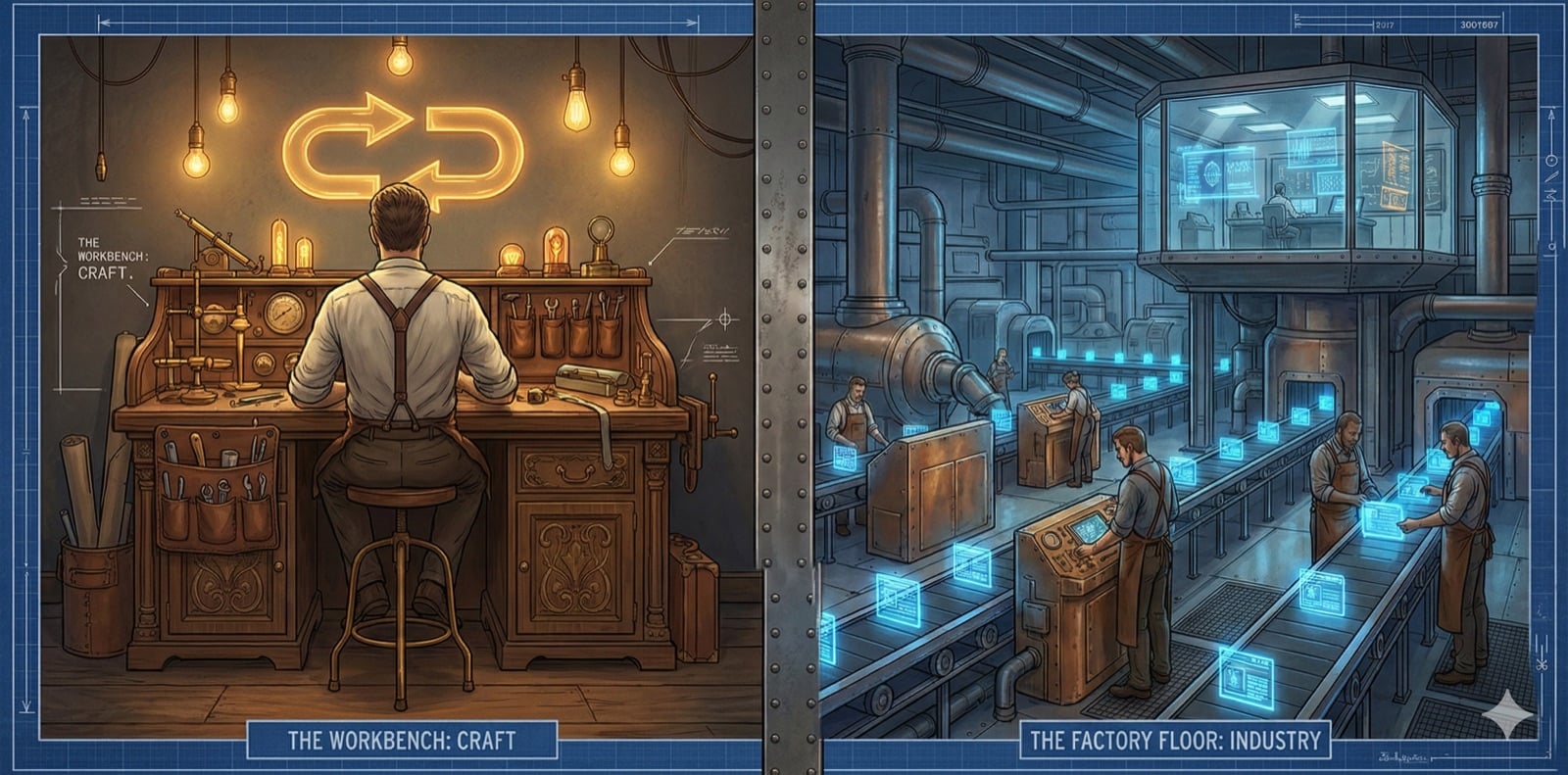
Every agentic coding tool in 2025 sat on the same foundation: the REPL. Elegant. Simple. Doesn't scale without help. If you've burned hundreds of dollars overnight on a spiral, you already know.
The Pattern Everyone Loves
The agent execution loop is gospel: prepare context, call model, handle response, iterate until done. Replit Agent, GitHub Copilot agent mode, Claude Code, Cursor. Victor Dibia's explainer captures it well.
Geoffrey Huntley's Ralph pattern made it a meme: a bash loop that keeps feeding the agent until tests pass. I ran Ralph overnight. Then the quality collapsed.
The 50 First Dates Problem
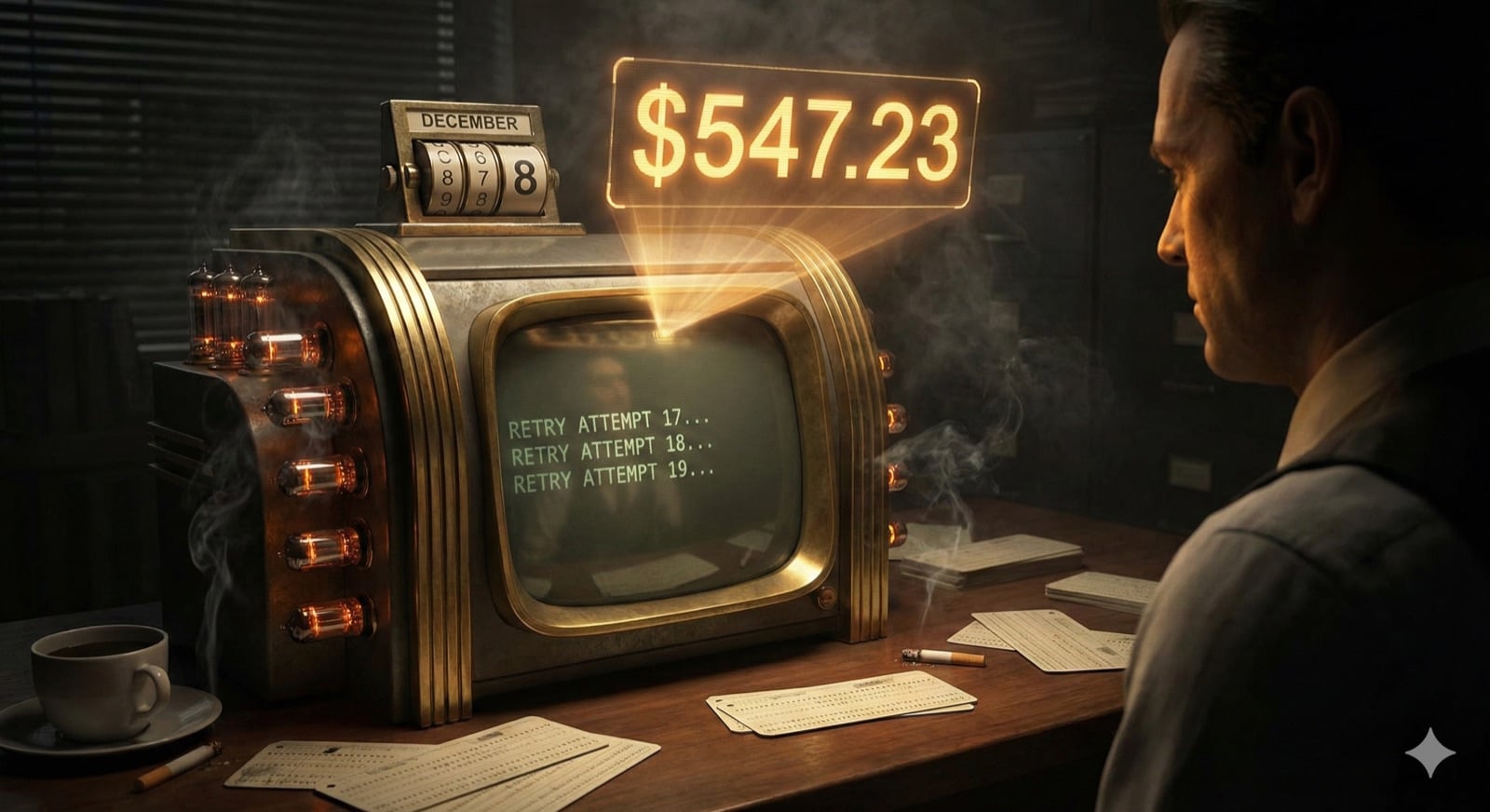
The failure mode nobody warns you about: the agent spirals on the same bug for hours, confident it's making progress. It'll try the same fix seventeen times with minor variations, each time expecting different results.
It's not insanity. It's optimism without memory.
The REPL pattern is stateless by design. Every iteration starts fresh. The loop doesn't know what already failed. It's Drew Barrymore waking up every morning in 50 First Dates, except instead of falling in love with you, it's falling in love with solutions that already didn't work.
One day cost $547 in burned tokens. This is what it looked like.
The Architectural Problem
OK, so you add state. Memory. Persistence. That helps with single-agent work.
But this breaks at scale. You run 3+ agents. They all need coordination. The coordinator needs to know what each agent is doing.
Classic multi-agent pattern: workers report back to a boss. Every result flows into the coordinator's context.
Math time (the old way):
- 8 agents
- 10K tokens each
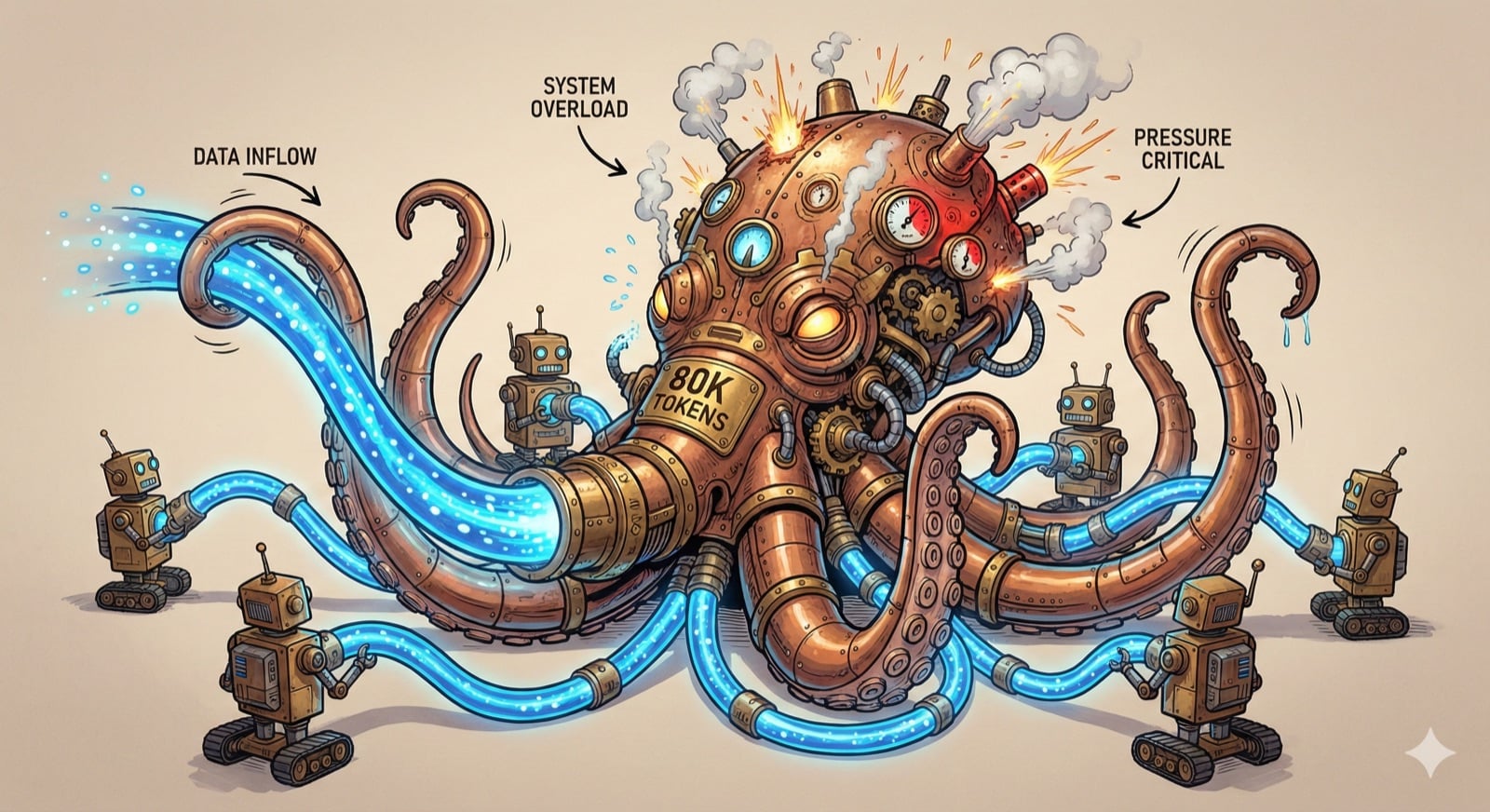
- 80K tokens consumed in the coordinator
The boss becomes the bottleneck. Context fills up. Performance degrades. The expensive model (the one doing the coordination) chokes on data it doesn't need.
SWE-Bench Pro quantified the cliff: on simple single-file tasks, top models score 70%+. On realistic multi-file enterprise problems? GPT-5 and Claude Opus 4.1 drop to 23%. The performance cliff is brutal. Beyond 3 files, even frontier models struggle. Beyond 10 files, open-source alternatives hit near-zero. The study tests model capability, not execution patterns, but it explains why decomposition matters. Smaller tasks mean smaller contexts mean staying on the good side of the cliff.
I built this multi-agent coordinator before I found Gas Town. I called it "the kraken." I should have called it "the money pit."
The Factory Analogy
Steve nailed it in The Future of Coding Agents: coding agent shops think they've built workers. What they need is a factory.
A factory doesn't funnel all work product to a single manager who inspects every widget. A factory has:
- Workers who operate in isolation
- Status boards (not detailed reports)
- Quality gates (not real-time supervision)
- Graceful failure handling (not cascade failures)
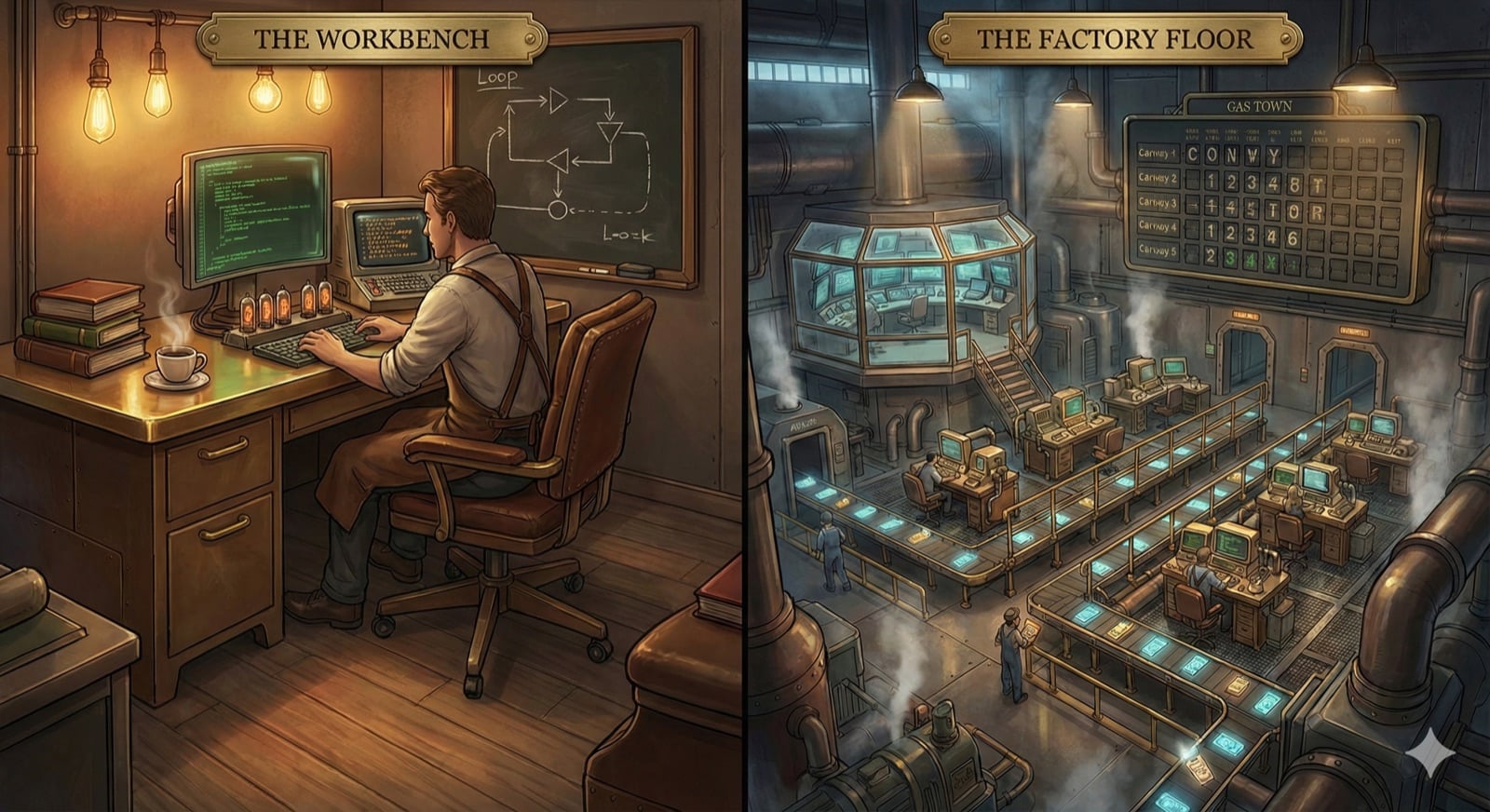
The REPL is a workbench. You stand at it. You do the work. It's fine for one person. Solo queue.
Gas Town is closer to a production line than a workbench. You manage capacity. You track throughput. You handle failures without stopping the line. Soloing a dungeon vs running it with a coordinated party: same content, different throughput, different failure modes.
From REPL to ODMCR
Gas Town doesn't replace the REPL. It's what the REPL becomes when you add orchestration.
The insight: don't have agents return their work to a coordinator.
Each worker (Steve calls them "polecats") runs in complete isolation:
- Own terminal
- Own copy of the code
- Results go straight to git and a shared issue tracker
The coordinator (Mayor) just reads status updates from the tracker. It never loads the actual work. It doesn't know what the code looks like; it knows what the tickets look like. The coordinator manages work, not syntax.
What keeps it moving? Steve calls it GUPP, the Gastown Universal Propulsion Principle: "If there is work on your hook, YOU MUST RUN IT." Every worker has a persistent hook in the Beads database. Sling work to that hook, and the agent picks it up automatically. Sessions crash, context fills up, doesn't matter. The next session reads the hook and continues.
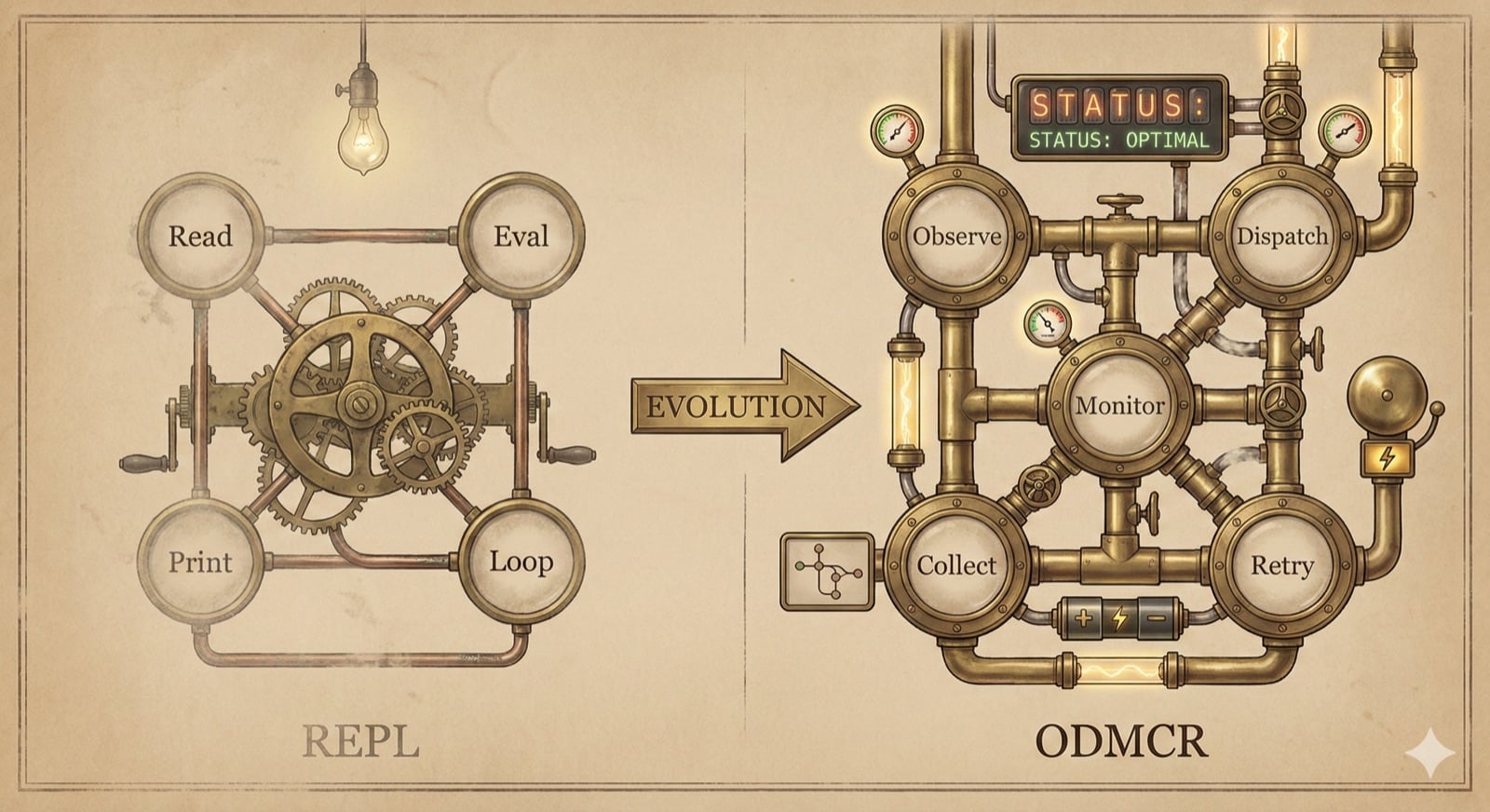
ODMCR: The Evolution
I've been running Gas Town for two weeks. The working loop that emerged: observe, dispatch, monitor, collect, retry. ODMCR, as shorthand for the rest of this post, not a movement. Two weeks is enough to see a shape, not to name a paradigm.
Underneath ODMCR is Steve's MEOW stack, Molecular Expression of Work. Beads chain into molecules, which cook from formulas. Work becomes a graph of connected nodes in Git, not ephemeral context in a model's head. The workflow survives the session.
| REPL Phase | ODMCR Phase | What Changed |
|---|---|---|
| Read | Observe | Multi-source state discovery (issues, git, convoy status) |
| Eval | Dispatch | Async execution to polecats, not blocking |
| Monitor | Low-token polling (~100 tokens vs 80K) | |
| (implicit) | Collect | Explicit verification of claimed completions |
| (implicit) | Retry | Exponential backoff with escalation |
The coordinator stays light. ~750 tokens per iteration median, range 400-2,500. The high end hits when multiple polecats report errors simultaneously. Sustainable for 8-hour autonomous runs at the median; spiky loads require headroom.
Steve calls the durability guarantee NDI, Nondeterministic Idempotence. The path through the workflow is unpredictable (agents crash, retry, take different routes), but the outcome converges as long as you keep throwing sessions at the hook. For unsolvable tasks, the system detects spiral patterns and escalates to human review. The pattern achieves Temporal-like durable execution through Git-backed state instead of event sourcing, without Temporal's enterprise hardening.
REPL assumes you're present. ODMCR assumes you're not.
The 40% Rule
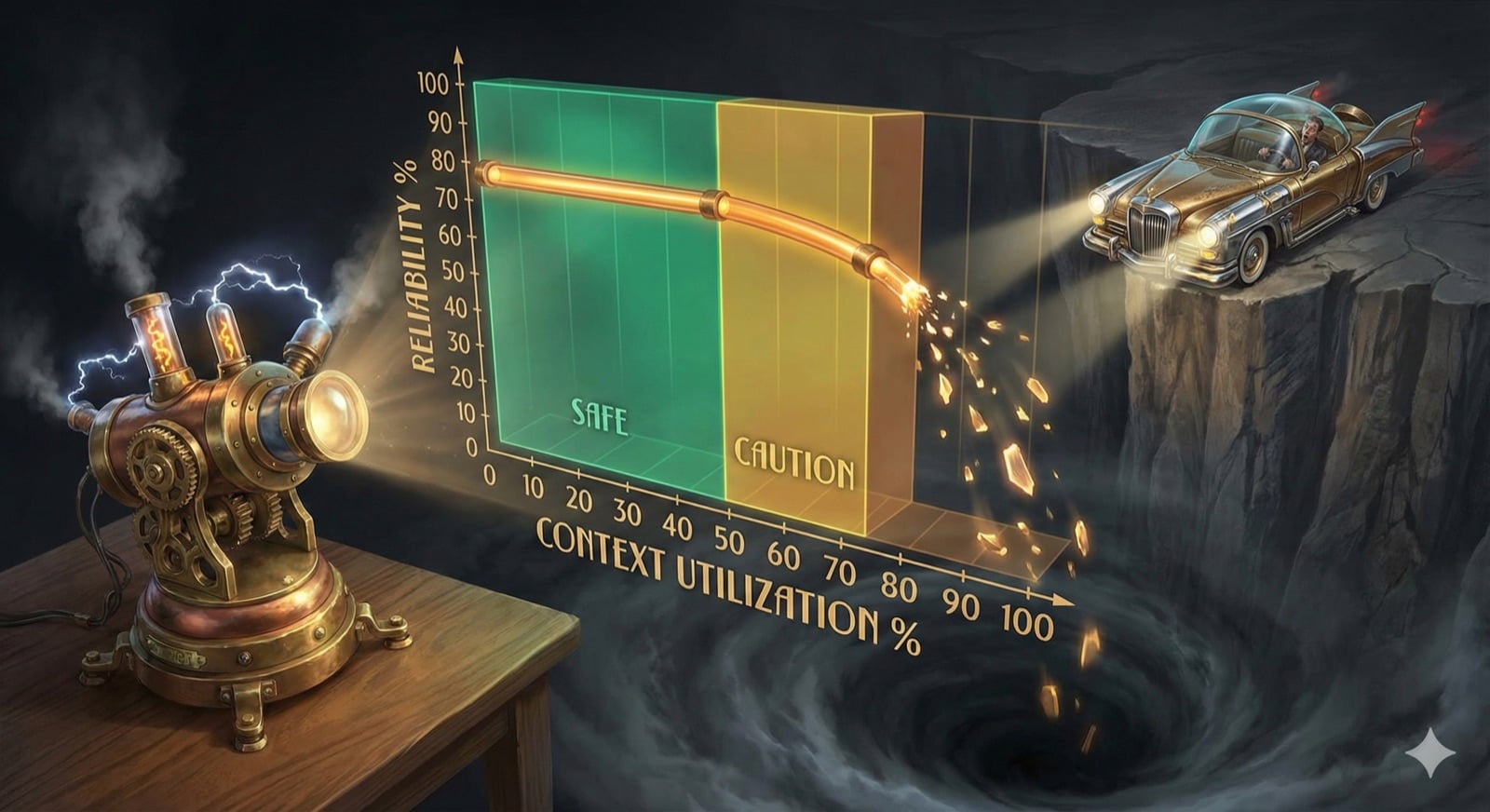
Never exceed 40% context utilization. Chroma's research shows LLMs don't degrade gracefully. They hit cliffs. A model advertising 200K tokens typically fails around 130K. My 40% threshold is conservative. I'd rather leave money on the table than watch an agent spiral.
The failure modes: context pollution, context confusion, context poisoning. Each bad token compounds. The model doesn't flag the degradation. It just starts producing confident garbage. By the time you notice, the whole session is unsalvageable.
Every REPL iteration compounds these losses. ODMCR sidesteps this: workers write to Git, not back to a coordinator's context. No summarization chain. The detail lives in the commit, not in compressed memory.
The Shift
Two weeks. Personal projects across 8 repos. Week one: Ralph. Week two: Gas Town.
The main change was operating model, not a single metric. REPL required constant supervision and frequent restarts from context bloat. ODMCR moved work into durable queues with isolated workers, which made multi-file changes easier to run and recover.
What I valued most then: searchable issue history. Every closed issue becomes a pattern I can find again. Every formula that works gets templated. When I start a new task, I search past work first. That habit is real. Calling it a compounding moat was premature; the first honest A/B in Devlog #6 didn't back it.
n=1. Personal projects. Not controlled. Week 2 benefited from Week 1 learnings, and task complexity varied. Directional, not definitive.
When It Fails
Gas Town isn't magic. The failure modes I've hit:
- Retry spirals: Polecat gets stuck, burns tokens. Fix: validation gates that escalate to human review.
- Merge conflicts: Two polecats touch the same file. Fix: one file, one owner.
- False completions: Agent claims "done" when it's not. Fix: explicit verification, not trust.
Every system fails. The question is how it fails. REPL failures cascade. One bad context poisons everything. ODMCR failures isolate. You lose one polecat's work, not the whole convoy.
Why Not Just Wait?
Models improve fast. The next model generation might handle multi-file tasks natively. Why build orchestration complexity?
The problem is architectural.
TSMC doesn't make one giant chip. They make billions of small ones with extreme precision. "But code isn't standardized widgets!" True. The decomposition is the hard part: breaking "design auth system" into "add JWT validation to middleware," "create token refresh endpoint," "write integration tests." That's what the issue tracker and workflow templates are for. The factory pattern (decomposition, parallelism, quality gates) scales regardless of how good individual components get.
Important caveat: not all work decomposes cleanly. Research spikes, architectural explorations, and genuinely novel algorithms resist templating. The factory pattern works for production code (CRUD endpoints, test coverage, refactoring), not R&D. I still use single-agent REPL for exploratory work where the goal is understanding, not output. The factory is for when you know what to build; the workbench is for figuring out what to build.
Better models won't eliminate the need for orchestration. They'll make orchestration more powerful. A factory of next-gen agents will outperform a single one the same way a factory of today's agents outperforms a single one now.
Orchestration and validation gates are the durable part of the stack. Searchable issue history plus reusable formulas is a practice I still run (~2 minutes to capture). As a compounding moat against a current model, it's unproven (Devlog #6).
Try It
The stack:
- Beads - Git-backed issue tracking. The shared memory that survives sessions.
- Gas Town - Orchestration system. The factory.
- Vibe Coding - Gene Kim & Steve. The philosophy.
Steve built the orchestration system. I run this discipline on production multi-agent systems where reliability and security are the bar. This is the operating pattern, field-tested.
The Prediction
The REPL got us here. Orchestration gets us where we're going.
Steve predicts 2026 brings a new class of "100x engineer," people who've figured out how to wield agent orchestrators effectively. The bottleneck is how fast humans can review code, so the game is better orchestration of the agents you have, not more agents.
By end of 2026, at least two major players (Cursor, Copilot, Claude Code, Replit, Windsurf, or something new from Google or OpenAI) will ship orchestration primitives: multi-agent coordination, persistent workflow state, or declarative work queues. The single-agent REPL will still exist for simple tasks. Serious production use will look closer to ODMCR.
Update (May 2026): this is already landing. Major tools are shipping multi-agent coordination and persistent workflow state.
The winning pattern is the best orchestration of whatever models exist, regardless of which is smartest.
The natural next step: Kubernetes-style operators for agent orchestration. Declare your desired state, let the operator reconcile. The CLI is the proving ground, the kubectl before the control plane.
We've done this before. DevOps taught us how to make unreliable things reliable. AI agents are just the newest unreliable component.
This is the discipline between generation and trust: the gap between an agent producing output and that output being correct, safe, and worth shipping.
The foundation: 12-Factor AgentOps, infrastructure patterns for AI workflows. The journey: my vibe coding devlog series has the failure log, the Ralph collapse, and the practical .claude/ setup. This piece is the prediction.